
HIP Reflective Film & ASTM D4956 Type IV HIP Sheeting Vinyl Sticker Guide
- Manufacturing HIP reflective film and many other reflective sign sheeting materials since 2008
- Fully meets ASTM D4956 Type III, IV and EN 12899 Class RA2 requirements
- Cost-effective alternatives to 3M HIP 3930, Avery Dennison T-6500 and ORAFOL Oralite 5900 reflective sheeting
MOQ 1 Unit | Fast Lead Time | 365 Days Max Support
How Does HIP Reflective Film Work?
HIP reflective film is also called HIP reflective sheeting (High Intensity Prismatic), which is a reflective material that uses a non-metalized microprismatic structure to reflect light back toward its source. This design helps drivers see traffic signs more clearly at night when their headlights illuminate the sign surface. It is required to comply with ASTM D4956 Type IV or Europe’s Class RA2 specifications.
Unlike Engineer Grade beaded reflective sheeting, which uses glass beads, ASTM D4956 Type IV high intensity prismatic HIP reflective sheeting material relies on small prisms to provide high retroreflective performance. HIP reflective sign material produces a brighter, clearer sign image under suitable lighting and observation conditions. For common colors, including white, red, yellow, green, and blue, HIP is about five times as bright as glass bead Engineer Grade sheeting.
HIP reflective vinyl film or HIP sign sheeting is commonly used for traffic signs, highway signs, and other road safety applications. And HIP reflective tape is also available for conspicuity marking applications. Its actual performance depends on the product specifications, color, installation conditions, and viewing angle.
What Are the Key Features of ASTM D4956 Type IV HIP Reflective Sheeting?
ASTM D4956 Type IV HIP reflective sheet sticker uses microprismatic technology to deliver high retroreflectivity and improve nighttime sign visibility.
Key features include:
High retroreflectivity: White Type IV high intensity prismatic HIP reflective sheet has a minimum initial coefficient of retroreflection (RA) of 360 cd/(lx·m²), while yellow sheeting has a minimum of 270 cd/(lx·m²), measured at a 0.2° observation angle and a −4° entrance angle. Actual reflectivity is much higher. To find out the general retro-reflection reading of different brands like 3M, Orafol Oralite, Avery Dennison or China reflective sheeting suppliers, you can check Road Sign Sheeting Reflectivity & Reflective Tape Lifespan Free Check Tool for more details.
Improved nighttime visibility: High retroreflectivity helps drivers recognize traffic signs in low-light conditions. Actual viewing distance depends on sign size, color, headlight output, viewing geometry, and road conditions.
Microprismatic structure: Small micro prisms return light toward its source, unlike the glass-bead structure used in conventional Engineer Grade sheeting.
Daytime color visibility: Color and luminance requirements help signs remain recognizable in daylight as well as at night.
Outdoor durability: Designed for outdoor vertical exposure with a typical lifespan of 10 years.
Standards and Specifications: It is suppose to meet ASTM D4956 Type IV or Europe’s RA2 standards.
Adhesive: Usually use permanent, pressure-sensitive adhesive.
- Rigidity: Owing to its microprismatic structure, HIP reflective material is significantly stiffer than flexible glass-bead reflective tapes. It resists conforming to sharp curves or flexible objects like cones, which can cause cracking or edge-lifting over time.
Common colors: White, red, yellow, green, blue and also fluorescent colors like fluorescent yellow green
These figures are standard minimum values, not guaranteed readings for every product or color. Buyers should check the applicable ASTM requirements and the manufacturer’s test report for the specific HIP reflective vinyl.
Where Is HIP Reflective Film Used?
HIP reflective sticker or HIP sign sheeting is widely used for traffic signs that need high nighttime visibility and reliable outdoor performance. Its microprismatic structure helps return vehicle headlight energy toward drivers, making signs easier to detect and recognize in low-light conditions.
Common applications include:
Highway and expressway signs: Helps improve the nighttime visibility of direction signs, route markers, and advance warning signs.
Regulatory signs: Used for stop signs, speed limit signs, and other signs that communicate traffic rules.
Warning signs: Suitable for signs that alert drivers to curves, road hazards, intersections, and changing road conditions.
Work zone signs: Used for work zone signs, construction area barrels, barricades, and cones where clear visibility is important, subject to the project requirements.
General road safety signs: Suitable for many permanent traffic sign applications that require high-intensity retroreflective performance.
Before selecting HIP reflective vinyl, buyers should check the required ASTM D4956 classification, local road authority specifications, HIP reflective sign colors, and installation conditions. The correct grade depends on the intended use and applicable regulations.
What is HIP Reflective Tape
HIP reflective tape stands for High Intensity Prismatic reflective sheeting/tape. It uses a non-metalized microprismatic structure instead of glass beads to bounce light back toward its source, widely used for conspicuity marking, vehicle marking tape, reflective conspicuity tape, chevron reflective tape and many other traffic safety applications.
Which Reflective Sheeting Grade Should You Choose? EG, HIP or DG Sheeting Vinyl?
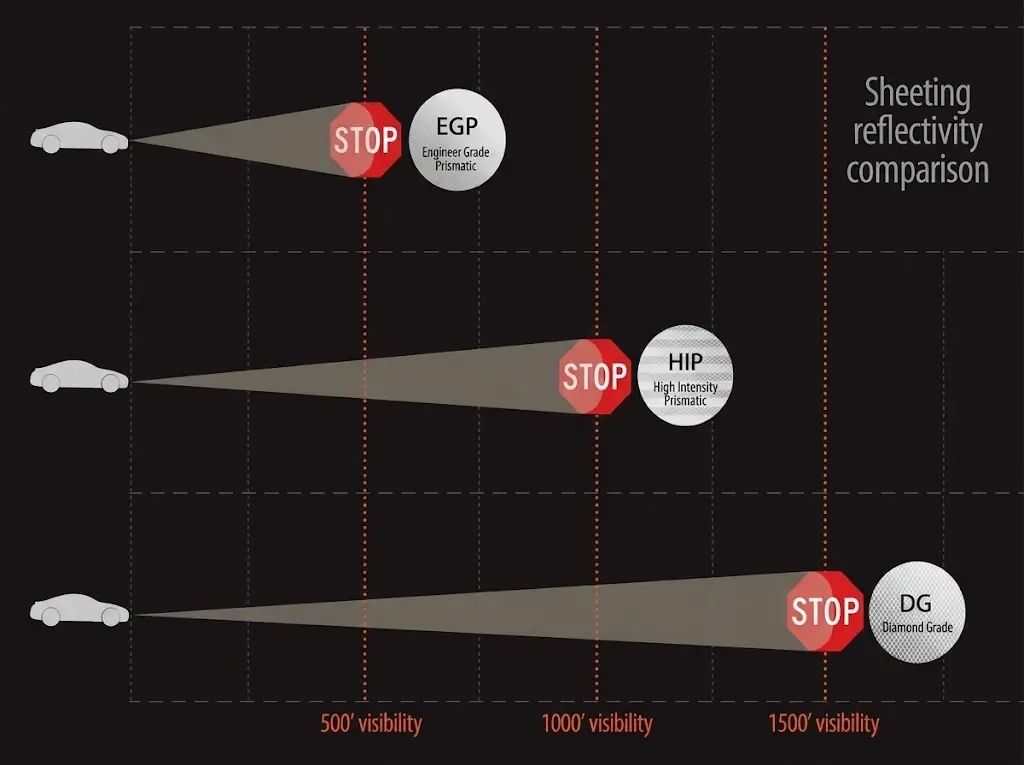
Engineer Grade (EG), High Intensity Prismatic reflective sheet (HIP), and Diamond Grade (DG) reflective film differ in brightness, optical technology, cost, and typical applications.
Brightness: EG offers basic nighttime visibility, HIP reflective sheeting provides higher retroreflectivity, and DG is designed for the highest retroreflective performance in wider angles. Actual performance depends on the product specifications and viewing conditions.
Optical technology: EG typically uses glass beads, while HIP reflective vinyl uses microprismatic optics. DG commonly uses full-cube prismatic technology for high light-return efficiency.
Cost: EG is generally the most economical option, HIP reflective material sits in the middle, and DG usually costs more due to its higher-performance optical design.
Typical applications: EG suits many basic signs on lower-speed roads. HIP is suitable for a wide range of traffic signs on busy roads and highways, while DG is often selected for demanding locations where high visibility is a priority.
TOPTEND HIP Reflective Vinyl: A Cost-Effective Alternative to 3M HIP 3930, Avery Dennison T-6500 & ORAFOL ORALITE 5900
Check out our H1630 high intensity prismatic reflective sheeting (HIP reflective vinyl sticker) or contact us now for money saving! Low MOQ, fast lead time, 365 days supports with product warranty.
