
Choosing the Right Reflective Sheeting: A Comprehensive Guide
- Manufacturing reflective sheeting since 2008
- Fully meets ASTM D4956 Type I, III, IV, IX & XI and EN 12899 Class RA1, RA2, RA3, R3B & R3C requirements
- Cost-effective alternatives to 3M, Avery Dennison and ORAFOL Oralite reflective sheeting
MOQ 1 Unit | Fast Lead Time | 365 Days Max Support
High Intensity Prismatic vs Engineer Grade vs Diamond Grade: Key Differences
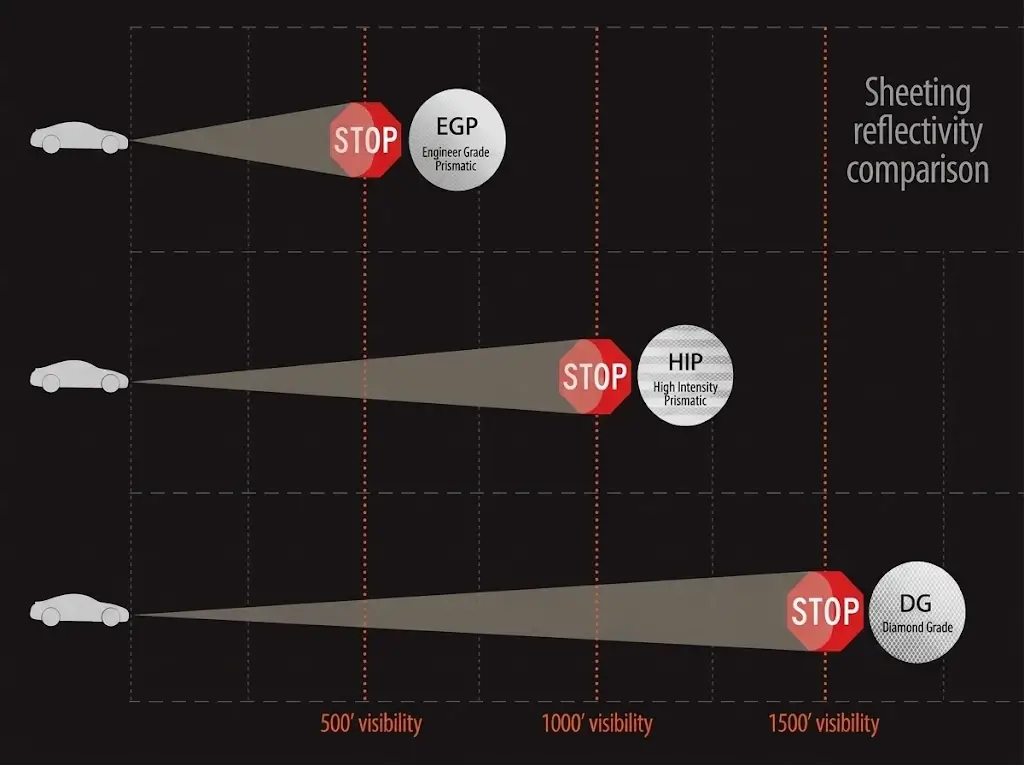
High Intensity Prismatic (HIP), Engineer Grade, and Diamond Grade reflective sheeting differ in optical design, retroreflectivity, cost, and road sign applications. Engineer Grade is a cost-effective choice for many basic signs, while HIP offers higher visibility for road traffic control. Diamond Grade retroreflective sheeting provides the highest retroreflective performance for demanding and critical applications.
| Feature | Engineer Grade | High Intensity Prismatic (HIP) | Diamond Grade |
|---|---|---|---|
| Optical structure | Glass bead or prismatic | Prismatic optics | Full-cube prismatic optics in selected product lines |
| Retroreflectivity | Lower | Higher | The highest |
| Min. ASTM D4956 Retroreflectivity (White Sheeting, 0.2° Obs. / −4° Ent.) | 70 (Type I) | 360 (Type IV) | 380 (Type IX) / 580 (Type XI) |
| Cost | Generally lower | Generally higher | Generally highest |
| Service life/Durability | Typically 5–7 years | Typically 10 years | Typically 10–12 years |
| Typical applications | Parking signs and basic traffic signs | Road signs requiring increased visibility | High-performance traffic signs and demanding road conditions |
| Standards | ASTM Type I / En 12899 Class R1 or RA1 | ASTM Type IV / En 12899 Class R2 or RA2 | ASTM Type IX & XI / En 12899 Class R3 or RA3, R3B, R3C |
The exact performance and service life of retroreflective sheet depend on the brand, specific product, color, test conditions, and applicable standards. Check the manufacturer’s technical data sheet before comparing grades, as commercial names like above do not guarantee the same ASTM or En 12899 types among different reflective vinyl brands and suppliers on the market.
Diamond Grade Reflective Vinyl
ASTM D4956 Type IX & XI / Class RA3, R3B, R3C
High Intensity Prismatic vs Diamond Grade
High Intensity Prismatic (HIP) and Diamond Grade reflective sheeting both use prismatic optics, but they differ in micro prism design and retroreflective performance. HIP offers high visibility at a controlled cost, while Diamond Grade uses full-cube prismatic technology to deliver the highest retroreflectivity among these three grades.
The main differences are:
Retroreflectivity: Diamond Grade full-cube prismatic sheeting ASTM D4956 Type IX and XI offers the highest retroreflectivity among Engineer Grade, ASTM Type IV high intensity prismatic, and Diamond Grade retroreflective film.
Full-cube technology: Unlike designs that use partial cube corners, full-cube prisms use more of the cube-corner geometry to return incident light toward its source. This design can improve light-return efficiency and support high retroreflective performance.
Viewing angles: Full-cube prismatic designs can provide strong retroreflection at wider observation angles, helping drivers see road signs under different viewing conditions. Actual performance depends on the product’s optical design and test data of different brands or manufacturers
Cost: HIP usually is cheaper than Diamond Grade reflective sheets
Applications: HIP reflective film suits many standard road sign projects. Diamond Grade is often selected for high-speed roads and signs that require very high visibility like highway signs.
Before choosing, compare the actual ASTM D4956 or En 12899 types, specific color retroreflectivity data, warranty, and service life. Check each product’s technical data, since performance can vary by model and manufacturer.
High Intensity Prismatic vs Engineer Grade
High Intensity Prismatic (HIP) and Engineer Grade reflective sheeting differ in optical structure, retroreflectivity, and cost. Engineer Grade reflective vinyl uses glass bead or prismatic technology and is often selected for basic signs with limited budgets. HIP uses prismatic technology to return more light toward drivers, making it a better choice for many road signs that need higher nighttime visibility.
The main differences are:
Optical structure: ASTM Type I Engineer Grade reflective sheeting film uses glass beads or prismatic, while HIP only uses prismatic optics designed to improve light return.
Retroreflectivity: HIP generally provides higher retroreflectivity than Engineer Grade, helping signs remain more visible at night when illuminated by vehicle headlights.
Cost: Engineer Grade usually has a lower purchase price. HIP costs more but may be worth the added cost when visibility requirements are higher.
Applications: Engineer Grade reflective film is commonly used for parking signs, private roads, and basic traffic signs. HIP is often used for road signs that require stronger nighttime visibility.
Standards: Engineer Grade corresponds to ASTM D4956 Type I or EN 12899 Class R1/ RA1, while HIP often corresponds to Type IV. Always verify the exact product specification and required standard.
When choosing between the two, consider the road authority’s requirements, the sign’s location, nighttime visibility needs, and the project budget. HIP is much more popular than glass bead EG or EGP/PEG nowadays.
Which Reflective Sheeting Grade Should You Choose?
The right reflective sheeting grade depends on your road sign requirements, visibility needs, and budget. Engineer Grade suits many basic signs, HIP offers higher nighttime visibility, and Diamond Grade is a suitable choice for projects that require the highest retroreflective performance.
Choose Engineer Grade for parking signs, private roads, and basic traffic signs where the project specification allows it and low cost is a priority.
Choose High Intensity Prismatic (HIP) for road signs that need stronger nighttime visibility without the higher cost of premium full-cube sheeting.
Choose Diamond Grade for demanding traffic sign applications where the highest retroreflectivity in wider angles and strong visibility are key requirements.
Before placing an order, confirm the required ASTM D4956 type or EN 12899 class, the sign color, and the minimum retroreflectivity values. Compare warranty terms and service-life data for the exact product rather than relying on grade names alone.
For bulk orders, ask your supplier for the technical data sheet and test reports for the proposed grade. This helps you check compliance before production and compare alternatives before making a wise decision.
What is the Difference Between Class 1 and Class 2 Reflective Signs?
In Europe, reflective sheeting for road signs is commonly specified using EN 12899-1 performance classes such as RA1 and RA2. In Australia, the classification was updated in 2017, so older documents may use Class 1 and Class 2, while newer specifications use numerical classes such as 100, 300, 400, 900 and 1100 according to AS/NZS 1906.1. These classifications are not directly interchangeable, so buyers should confirm the applicable standard and required performance before selecting reflective sheeting.
What is the Difference Between RA1 and RA2 Reflective Vinyl?
RA1 and RA2 are retroreflective classes used for road signs under EN 12899-1. RA2 generally requires higher retroreflective performance than RA1, helping signs return more headlight illumination toward drivers at night. The correct class depends on the road authority’s requirements and the sign’s intended application.
The main differences are:
Retroreflectivity: RA2 reflective film has higher minimum retroreflective performance requirements than RA1, improving nighttime visibility under the specified measurement conditions.
Material technology: Both RA1 and RA2 use glass-bead or prismatic technology, and prismatic is more popular while beaded reflective vinyl sometimes is more sutiable for some specific applications due to its soft and flexible features.
Applications: RA1 may be suitable for some lower-demand applications, while RA2 is often specified where greater nighttime visibility is required. Always follow local road-sign regulations.
Cost: RA2 reflective vinyl usually cost more than RA1 products although actual prices depend on the product and supplier.
When choosing between RA1 and RA2 reflective sheeting, check the required EN 12899-1 class, color-specific retroreflectivity values, and the product’s technical data sheet. Do not rely on the grade name alone, because products within a class can have different optical performance levels.
