

MOQ 1 Unit | Fast Lead Time | 365 Days Max Support


Reflective Technology: Both metalized or non-metalized prismatic reflective tape options avaiable. Flexible or rigid options. See below for details.
Colors: white, red, yellow, blue, green, flourescent yellow green, fluorescent orange, pre-striped white/red, yellow/black and more.
Width: 2.5cm, 5cm, 7.5cm, 10cm or 1″, 2″, 3″, 4″ and other customized width.
Length: 45.7m, 50m or 50 yards and other customsized length.
Specifications: DOT, FMVSS 108, ECE104, ECE 150, IRAM I.3952/5, SASO 2913 and more.
Durability: up to 10 years service life with strong pressure sensitive adhesive.


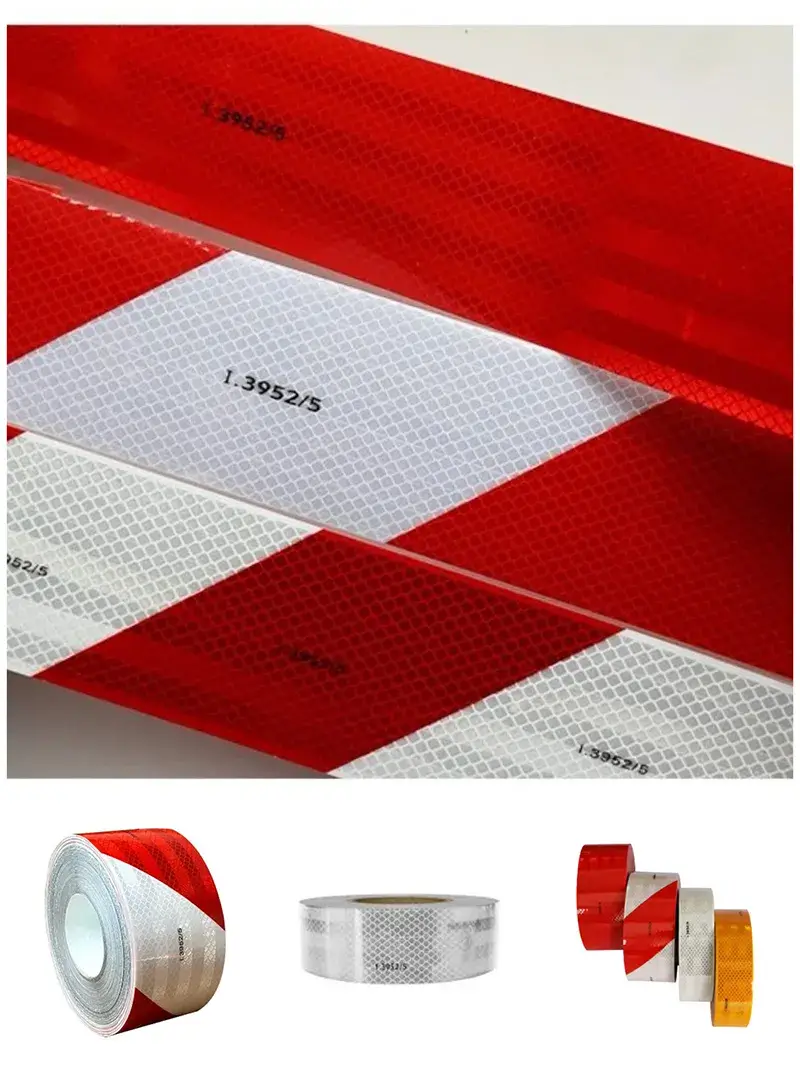
Microprismatic reflective tape is a retro-reflective tape that uses thousands of tiny prisms to reflect light back toward its source. Its prism-based optical structure provides stronger nighttime visibility and helps people and vehicles remain more visible in low-light conditions than the beaded engineer grade materials.
Microprismatic reflective tape is widely used for vehicle markings, safety barriers, trailers, post bands, traffic cone collars and other safety applications. Its brightness, viewing angle, and service life depend on the material grade and design.
For road safety and industrial use, buyers should check the relevant performance standards, material types and outdoor durability before selecting a micro prismatic retro reflective tape.
Metalized and non-metalized prismatic reflective tapes differ mainly in their optical structure and light-return methods. Both use cube-corner prisms, but their designs affect brightness, sealing and application.
Metalized tape uses a thin metallic coating behind the prisms to reflect incoming light. It has a single-layer structure, requires no edge sealing, and is softer for application on curved surfaces.
Non-metalized tape uses an air-backed structure and total internal reflection at the prism-air interface. Its edges may require proper sealing to prevent moisture from entering and affecting optical performance.
Both types are used for vehicle or various conspicuity markings applications, including ECE 104 and DOT reflective conspicuity tape applications.
Engineer Grade Prismatic (ASTM D4956 Type I or En12899 RA1, such as 3M EGP 3430): A microprismatic film designed to replace traditional glass-bead technology. It has 7-year outdoor service life, making it optimal for normal signs and markings like parking area signage, bollards and posts bands.
High Intensity Prismatic (ASTM D4956 Type III / IV, such as 3M HIP 3930, Oralite 5900): A highly durable, high-gloss microprismatic sheeting built for primary traffic control signs, work zones, with 10 years of outdoor weathering resistance.
Conspicuity & Vehicle Tape (DOT-C2, ECE 104, ECE 150 and many others, such as e.g., 3M Flexible Prismatic Conspicuity Tape / Oralite V98): Flexible metalized or non-metalized micro prismatic reflective tape or prismatic films specifically engineered to conform to vehicle contours, semi-trailers, and emergency apparatus, providing superior day and night recognition.
Vehicle & Fleet Safety: Applied to semi-trailers, fire apparatus, emergency vehicles, heavy machinery, and motorcycles to maximize visual recognition.
Infrastructure & Facility Hazards: Designed to mark structural edges, loading bays, access gates, utility poles, perimeter barricades, and traffic safety drums.
Traffic & Road Signage: Suitable for permanent roadway signs, work zone markers, directional guides, and high-visibility boundary indicators.

(Feel Free To Contact Us)