
High Intensity Prismatic Reflective Vinyl: Performance, Durability & Cost-Effective Options
- Toptend is a reliable and Top China Manufacturer of High Intensity Prismatic Vinyl and various grades of reflective sheeting vinyl products since 2008
- Fully meets ASTM D4956 Type III, IV and EN 12899 Class R2/RA2 requirements
- Cost-effective alternatives to 3M HIP 3930, Avery Dennison T-6500 and ORAFOL Oralite 5900 reflective sheeting film
MOQ 1 Unit | Fast Lead Time | 365 Days Max Support
What Is High Intensity Prismatic Reflective Vinyl?
High intensity prismatic reflective vinyl, also known as HIP vinyl, is a retroreflective material used for traffic signs and road safety applications. It uses tiny microprisms to return light toward its source, helping drivers see signs more clearly at night and in low-light conditions.
Traditional glass bead sheeting relies on small glass beads to reflect light, while High intensity prismatic vinyl uses a prismatic structure to provide higher levels of retroreflectivity. Its actual performance may vary among different HIP reflective vinyl manufacturers.
HIP reflective vinyl comes in different colours and roll sizes for sign production. Buyers should check the required standard, printing compatibility, outdoor durability, and intended application before choosing HIP reflective material products.
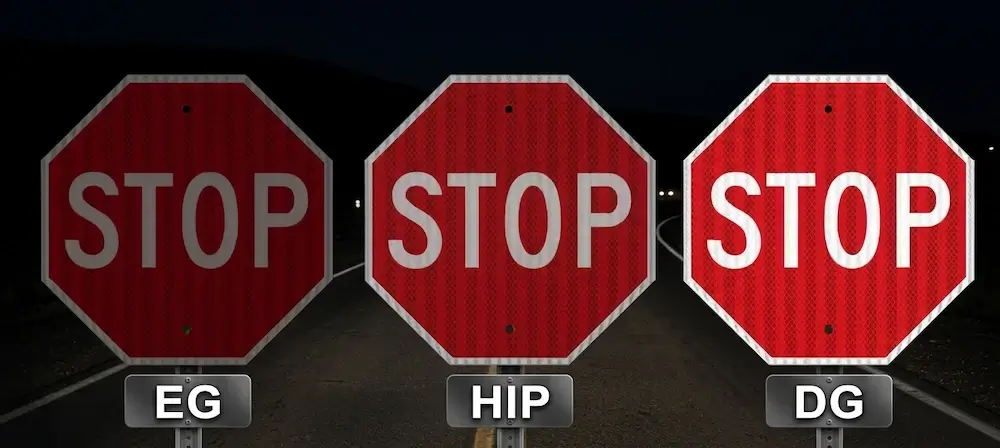
Key Characteristics, Technology & Standards of High Intensity Prismatic Vinyl
Optical Technology
HIP uses tiny microprisms to reflect light back toward vehicle headlights. Depending on the product design, the prism layer may be metallized or non-metallized. This structure provides higher retroreflectivity for traffic signs and other safety applications than engineer grade or EGP reflective vinyl.
ASTM D4956 and EN 12899-1 Compliance
High intensity prismatic reflective vinyl is available both under ASTM D4956 Type III and Type IV as well as European EN 12899-1 classifications R2 or RA2.
Reflectivity / Brightness
HIP reflective offers higher retroreflectivity than standard beaded engineer grade by about 4-5 times or higher and EGP sheeting by about 2-3 times or higher. The table below shows the minimum coefficient of retroreflection for three common colors among EG, HIP and DG, as required by ASTM D4956.
| Color | EG (Type I) | HIP (Type IV) | DG (Type XI) |
|---|---|---|---|
| White | 70 | 360 | 580 |
| Yellow | 50 | 270 | 435 |
| Red | 14 | 65 | 87 |
Minimum coefficient of retroreflection (RA), measured at a 0.2° observation angle and −4° entrance angle. Unit: cd·lx⁻¹·m⁻².
These data are standard minimum values as required by ASTM D4956 , not guaranteed results for every manufacturer. Actual performance depends on the product design, test conditions and brands.

Applications
HIP is widely used for permanent and temporary road signs, street name blades, roadwork barricades, commercial markers, guidance boards, conspicuity markings, vehicle safety and other traffic safety applications.
Service Life / Durability
The expected durability or service life of HIP reflective vinyl sticker is 10 years as required by EN 12899 or ASTM D4956. The actual lifespan varies by specific product, environmental and UV exposure, installation conditions, and different manufacturers. A typical service life comparison is shown below for the three grades for your reference: EG, HIP and DG
| Sheeting Type | Typical Service Life |
|---|---|
| Engineer Grade (Type I or Class R1/ RA1) | 5 – 7 years |
| HIP (Type IV or or Class R2/ RA2) | 10 years |
| Diamond Grade (Type XI / XI or or Class R3/ RA3, R3B, R3C) | 10 years or longer, depending on the product and manufacturer |
Actual durability and warranty policy vary. Buyers should check and make sure the product warranty and lifespan before choosing HIP reflective sticker materials supplier for road signs and other traffic safety projects.
Hign Intensity Prismatic Vinyl Brands & Cost-efficient Options: 3M, Avery Dennison, Oralite & Toptend
While 3M (3930 Series), Avery Dennison (T-6500), and ORAFOL (ORALITE 5900) dominate the market for high-visibility traffic signs, Toptend High Intensity Prismatic Sheeting provides an affordable alternative.
You Save at least 40%–80% by using Toptend HIP material compared to big brands (depending on specs & quantity).
Engineered for reliability with long term manufacturing experience since 2008.
Compliant & Customizable: Toptend ensures full compliance with ASTM D4956 Type IV or EN 12899 Class R2/RA2.
