
Micro Prismatic Reflective Sheeting Film Material Manufacturer
- Manufacturing micro prismatic retro reflective sheeting vinyl film and many other reflective sheeting materials since 2008
- Fully meets ASTM D4956 Type I,III, IV, IX and XI and EN 12899 Class RA1, RA2, RA3, R3C, R3B, ECE 104, ECE 150 standards
- Cost-effective alternatives to 3M 3430, 3930 HIP, Avery Dennison T-2500, T-6500, T-11500 and ORAFOL Oralite 6700, 5900, 7900 or 9900 reflective sheeting
MOQ 1 Unit | Fast Lead Time | 365 Days Max Support
What is Micro Prismatic Reflective Sheeting?
Microprismatic reflective sheeting film is an advanced, high-performance retro-reflective material engineered to bounce light directly back toward its original source (such as vehicle headlights) with minimal dispersion. Unlike traditional glass-bead sheeting, which relies on embedded spherical glass lenses, micro prismatic retro reflective sheeting material uses thousands of microscopic, precision-molded cube-corner prisms per square inch.
Major Types of Microprismatic Reflective Sheeting
Air-Backed (Air-Gap Construction)
Air-backed microprismatic reflective film uses an air interface between the back of the microprisms and a backing layer to achieve total internal reflection (TIR). The prisms are typically arranged in sealed air cells to protect their optical surfaces from external contamination.
In some designs, exposed cut edges may allow moisture or dirt to enter the cells, potentially affecting adhesion and long-term performance. Edge sealing may therefore be required, depending on the product construction and manufacturer’s recommendations.
Metallized (Single-Layer Construction)
Metallized microprismatic reflective sheeting has no air gap behind the prisms. Instead, a thin reflective metallic coating, typically aluminum, is applied to the prism surfaces to provide specular reflection.
This single-layer construction of prismatic reflective film eliminates open air cells, reducing the risk of water or dirt entering through cut edges. As a result, many metallized products do not require edge sealing, making them suitable for cutting into letters, numbers, and custom shapes.
Common Types and Classes of Prismatic Reflective Sheeting
Prismatic reflective sheeting or material uses microprismatic cube-corner technology to bounce light back to its source with higher retroreflectivitity and efficiency than traditional glass-bead reflective sheets. It is available in several performance grades, from Engineer Grade Prismatic (EGP) to High Intensity Prismatic (HIP) and Diamond Grade. Each grade offers different levels of retroreflectivity, service life, and nighttime visibility.
In North America, products are commonly classified under ASTM D4956, while European and UK markets use classifications based on EN 12899-1 and its national annexes.
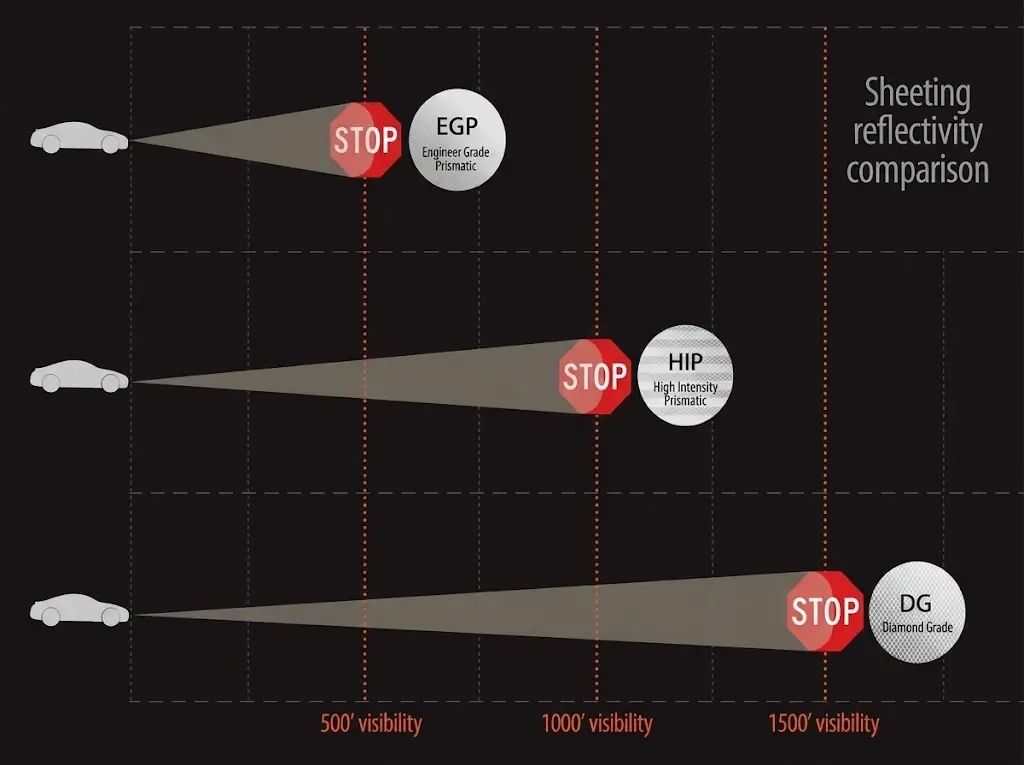
Microprismatic Reflective Film Grades, Lifespan & Applications Compared
| Performance Grade | ASTM D4956 (USA) | European / UK Classification | Example Products | Typical Service Life | Typical Applications |
|---|---|---|---|---|---|
| Engineer Grade Prismatic (EGP) | Type I | RA1 / R1 | 3M Series 3430 / ORALITE 6700 | Up to 7 years | Parking signs, private roads, commercial signs, and general wayfinding |
| High Intensity Prismatic (HIP) | Type III / IV | RA2 / R2 | 3M Series 3930; ORALITE 5910 | Up to 10 years | Regulatory signs, warning signs, urban roads, and work zone signs |
| High-Performance Microprismatic | Type IX / XI (product-dependent) | R3B-UK | High-performance microprismatic products | Product-dependent | Busy urban roads, complex junctions, and locations requiring enhanced nighttime visibility |
| Full-Cube Microprismatic | Type IX / XI (product-dependent) | R3C-UK; RA3 under applicable DIN classification | 3M DG³ Series 4000; Avery Dennison OmniCube T-11500; ORALITE 9900 | Up to 12 years | High-speed highways, overhead guide signs, expressways, and critical road safety signs |
Note: ASTM, EN and UK classifications are not directly interchangeable. RA1 and RA2 also cover glass-bead materials. R1, R2, R3B-UK and R3C-UK refer to specific UK classification routes. Always check the relevant product certification and technical data sheet.
Beyond traffic signs, microprismatic reflective materials are also widely used for vehicle graphics, conspicuity markings, micro prismatic reflective tape, and road safety applications.
Vehicle Markings: Used on ambulances, police cars, fire trucks, trailers, and construction vehicles. Examples include Avery Dennison VisiFlex™ V-8000, designed for high-visibility vehicle graphics and fleet markings.
Reflective Contour Tape: Applied to the sides and rear of trucks and trailers to improve nighttime visibility. Well-known products include 3M™ Diamond Grade™ Series 983, Avery Dennison V-5720, and ORALITE® VC 104+.
Road Safety Markings: Used on road barriers, construction equipment, and temporary work zones to help drivers identify hazards at night.
Important Selection & Usage Advices
Edge Sealing: Some air-backed prismatic retro reflective sheets require edge sealing to protect the air-cell structure from moisture and dirt. However, this depends on the product design and specific applications. Always follow the manufacturer’s installation instructions.
Check Certification and Intended Use: Not all microprismatic tapes are approved for public-road applications. Before use, check the relevant standards and approvals, such as ASTM D4956 for traffic sign sheeting or UN Regulation No. 104 or 150 (ECE 104 or ECE 150) for applicable vehicle conspicuity markings. General-purpose reflective tape may not meet these requirements.
Plotter and Cutting Compatibility: Do not assume every microprismatic sheet can be cut like ordinary reflective vinyl. Some rigid or cube-corner products may require specific cutting methods or compatible equipment. For colored graphics, check whether the material supports direct printing, electronic cut films, or screen printing. Products such as 3M ElectroCut are designed for use with compatible reflective sheeting systems.
How Is Micro Prismatic Different From Glass Bead Reflective Sheeting?
Glass bead and micro prismatic reflective sheeting use two different retro-reflection technologies. Glass bead sheeting relies on tiny spherical glass beads to bend and return light, while prismatic sheeting uses precision-formed cube-corner prisms to reflect light back toward its source. These different optical structures affect brightness, viewing performance, and material cost.
Glass bead sheeting uses thousands of tiny glass beads to return incoming light toward drivers. Its simple optical structure offers stable performance and good flexibility at a lower cost. It is commonly used for parking signs, private roads, and low-speed traffic areas. Micro prismatic reflective film uses precision-formed microprisms, often with cube-corner structures, to return more incoming light toward drivers. This design generally provides higher brightness and better long-distance visibility, making it suitable for highways, warning signs, and major road networks. However, its performance can vary with entrance angle and sheet orientation. The higher optical performance also comes with a higher material cost.
Differences Among Engineer Grade, High Intensity Prismatic & Diamond Grade Reflective Sheeting
Engineer Grade (EG) – ASTM Type I / EN 12899-1 Class RA1: Entry-level reflective sheeting using enclosed-lens glass bead (EG) or prismatic technology (EGP/PEG). It provides moderate retroreflectivity and is commonly used for parking signs, private roads, commercial signs, and general wayfinding.
High Intensity Prismatic (HIP) – ASTM Type III / IV / EN 12899-1 Class RA2: Higher-performance sheeting using encapsulated glass bead technology (Type III) or cube-corner microprismatic technology (Type IV). It offers improved nighttime visibility and is commonly used for STOP signs, speed limit signs, warning signs, urban roads, and work zones.
Diamond Grade (DG) – ASTM Type IX / XI / EN 12899-1 Class RA3, R3B, R3C: Premium microprismatic sheeting using advanced Full-Cube prism technology. Its full-cube structure improves retroreflective efficiency and wide-angle visibility, making it suitable for highways, high-speed roads, overhead signs, dangerous intersections, and other critical traffic safety applications.
Trusted Manufacturer of Micro Prismatic Reflective Sheeting
A Cost-Effective Alternative to 3M, Avery Dennison or ORAFOL ORALITE Prismatic Reflective
Toptend is a 15+ years of China-based manufacturer and supplier of microprismatic reflective sheeting and tapes for global businesses, distributors, sign makers, and vehicle marking companies. We offer a range of prismatic reflective materials for traffic signs, vehicle markings, road safety products, and other visibility applications, with cost-effective alternatives to leading international brands.
